
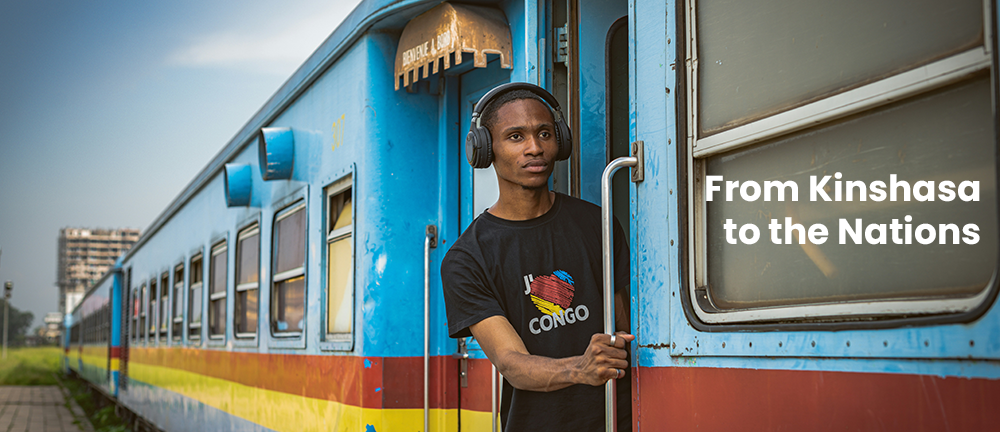
Photo by Johnnathan Tshibangu on Unsplash
From Kinshasa to the Nations: How Northwest College and Seminary is Helping Deepen Discipleship in Francophone Africa
The call to ministry does not always arrive in a single dramatic moment. For some, it unfolds slowly, faithfully, over a lifetime of obedience. For Reverend Matthieu, that calling began almost as early as he can remember—and it has carried him from the streets of Kinshasa to a discipleship movement now spanning more than twenty African nations.
Matthieu lives in Kinshasa, the capital of the Democratic Republic of Congo, where he serves as a university professor, pastor, and missionary leader. He is also in the midst of completing his doctoral dissertation. Alongside his ministry and academic work, Matthieu is a devoted husband and the proud father of six daughters—“all girls,” he says with a smile, calling them an unqualified blessing.
The Church in Congo: Wide but Not Always Deep
The Democratic Republic of Congo has often been described as a predominantly Christian nation. At one point, as many as 90 percent of Congolese identified as Christian. But Matthieu is quick to name the challenge beneath that statistic.
“For many,” he explains, “faith did not grow deep roots.”
The dominance of prosperity theology has shaped much of the church landscape. In a country marked by poverty and instability, messages promising material blessing attract large crowds. As a result, obedience, discipleship, and spiritual formation are often overshadowed by financial expectations. Many believers drift away—some returning to traditional religions, others adopting syncretistic practices that blend Christianity with older beliefs.
At the same time, new pressures are emerging. In unreached and rural regions, well-funded Islamic outreach efforts offer financial incentives to communities with little prior exposure to Christianity. In places where survival is uncertain, such offers carry weight.
These realities have convinced Matthieu that Africa does not merely need more churches—it needs deeper discipleship.
A Movement That Multiplies
Out of this conviction, Matthieu founded a discipleship-focused organization that began in Congo and has since expanded into 22 African countries. The fruit has been remarkable. As of 2025, the movement has documented more than 4,000 disciples and nearly 400 leaders currently in training.
What sets this work apart is its depth. Rather than gathering crowds, the focus is on forming leaders who can multiply ministry within their own cultural and religious contexts—often among unreached or high-risk communities.
Many of these leaders serve in regions where traditional theological education is inaccessible or impractical. Leaving ministry for five years of residential training is simply not an option. The need was clear: training that could happen alongside active ministry, not in isolation from it.
Rethinking Theological Education
Matthieu’s own graduate studies exposed him to disciple-making movements in Asia and other parts of the world—movements that emphasized practice, accountability, and multiplication rather than classroom-only instruction. Technology made it possible to imagine something new for Africa: training delivered through online platforms and virtual classrooms, reaching leaders wherever they serve.
This vision aligned powerfully with Northwest’s competency-based approach to theological education. Unlike traditional models that prioritize head knowledge alone, competency-based education integrates learning with real-life ministry practice.
“For the first time,” Matthieu says, “leaders can study, apply what they learn immediately, and remain rooted in their communities.”
Through careful discernment and reports from the field, leaders were identified from countries including Congo, Chad, Togo, Gabon, Angola, and Mali—many serving among Muslim or unreached peoples. These are men and women already bearing fruit, now being equipped to lead more faithfully and effectively.
A Vision for the Future
The long-term hope is bold but grounded: to train 100 African leaders through this program over the next ten years. The need is far greater—hundreds more are ready—but resources, technology, and connectivity remain ongoing challenges, especially in rural areas.
Still, Matthieu is confident. “The proof will be in the results,” he says. “When leaders are formed rather than elevated, when authority gives way to multiplication, the church grows—not just wider, but deeper.”
He is deeply grateful for the partnership with Northwest College and Seminary, the accessibility to an MA of Biblical Leadership degree made possible through grants, and the credibility of a respected institution walking alongside African-led mission work.
“This is something new for Africa,” Matthieu reflects. “And we believe God is in it.”
As the story continues to unfold, one thing is clear: from a boy preaching at twelve to a movement shaping leaders across a continent, God has been faithfully at work—planting roots that go deep, and raising leaders who will carry the gospel far.
How you can partner with Matthieu
Pray.
- Pray that theological resources can be available in the French language
- Pray for people to come alongside and translate for our English-speaking professors
- Pray that the students would have the time and discipline to commit to their students amidst the demands of family and ministry